
Marriage Green Card: Complete Evidence List for a Successful 2025 Application
When love crosses borders, the path to building a life together in the United States requires more than just commitment—it demands careful documentation. If you're married to a U.S. citizen or permanent resident and seeking to obtain a marriage green card, understanding what evidence you need to submit can feel overwhelming. The good news? With the right preparation and a clear checklist, you can navigate this process with confidence.
Disclaimer: This article provides general information only and does not constitute legal advice. Immigration law is complex and changes frequently. For guidance specific to your situation, consult with a qualified immigration attorney.
Key Takeaways
- Marriage green card applications require extensive documentation proving both the legal validity of your marriage and the genuine nature of your relationship.
- Core forms include I-130, I-485, I-693, and I-864, each with specific requirements and deadlines that must be met precisely.
- Financial evidence, cohabitation proof, and relationship documentation work together to demonstrate that your marriage is authentic and not entered solely for immigration benefits.
- Updated 2025 requirements include submitting medical examinations at the time of filing and using only the most current form editions.
- Working with an experienced immigration attorney can help you avoid costly mistakes and strengthen your application from the start.
Understanding the Marriage Green Card Process
What exactly is a marriage green card, and why does it require so much documentation?
A marriage green card—formally known as a marriage-based immigrant visa or lawful permanent residence through marriage—allows the foreign spouse of a U.S. citizen or permanent resident to live and work permanently in the United States[1]. The U.S. Citizenship and Immigration Services (USCIS) requires substantial evidence because marriage fraud remains a significant concern. Your application must prove two essential facts: that your marriage is legally valid and that it's genuine—entered into for love and commitment, not immigration benefits.
The documentation you provide serves as the foundation of your case. USCIS officers review every piece of evidence to build a complete picture of your relationship. Missing documents, inconsistencies, or insufficient proof can lead to delays, requests for additional evidence, or even denials.
We know this process can feel overwhelming. You don't have to face it alone—understanding what's required and preparing thoroughly will help you move forward with confidence.
Essential Forms for Your Marriage Green Card Application
Form I-130: Petition for Alien Relative
The I-130 is where your journey begins. This petition must be filed by your U.S. citizen or permanent resident spouse to establish the family relationship with USCIS[2]. Think of it as the official request asking the government to recognize your marriage for immigration purposes.
What you'll need for Form I-130:
- Marriage certificate (original or certified copy)
- Proof of U.S. citizenship or permanent residence for the petitioning spouse (birth certificate, passport, naturalization certificate, or green card)
- Proof of legal termination of any previous marriages for both spouses (divorce decrees, death certificates, annulment papers)
- Two passport-style photographs of each spouse
- Filing fee (check current USCIS fee schedule as amounts change)
Form I-485: Application to Register Permanent Residence
The I-485 is the actual application for your green card. As of April 3, 2025, only the 01/20/25 edition is accepted by USCIS[3]. Using an outdated version will result in rejection and delays.
Critical components of Form I-485:
- Biographical information including complete travel history
- Employment history for the past five years
- Address history for the past five years
- Information about family members both in the U.S. and abroad
- Two passport-style photographs
- Copy of birth certificate with certified English translation if needed
- Copy of passport (all pages, including blank ones and visa stamps)
Form I-693: Medical Examination
Starting in 2025, the medical examination must be submitted at the time of filing your I-485—it's no longer optional to wait until your interview[4]. This form must be completed by a USCIS-approved civil surgeon.
The medical exam includes:
- Physical examination and medical history review
- Vaccination records and administration of required vaccines
- TB test (tuberculin skin test or blood test)
- Blood tests for certain communicable diseases
- Mental health evaluation if indicated
The civil surgeon will seal the completed I-693 in an envelope. Do not open it—submit it sealed to USCIS.
Form I-864: Affidavit of Support
Your U.S. spouse must demonstrate they can financially support you and ensure you won't become a public charge[5]. The I-864 is a legally binding contract between your spouse and the U.S. government.
Required documents for I-864:
- Three years of tax returns from the U.S. sponsor (most recent year is mandatory)
- Proof of current income (recent pay stubs, W-2s, 1099s)
- Employment verification letter on company letterhead
- Proof of assets if income alone doesn't meet the threshold (bank statements, property deeds, investment accounts)
The sponsoring spouse must meet 125% of the Federal Poverty Guidelines for their household size. If they don't meet this threshold, a joint sponsor may be required.
Proving Your Marriage Is Legally Valid
The Marriage Certificate: Your Foundation Document
What makes a marriage certificate acceptable to USCIS?
Your marriage certificate is the single most important document in your entire application. It must be either an original issued by the government authority where you married or a certified copy from that same authority[6]. If your marriage certificate is not in English, you must include a certified translation along with a copy of the original foreign-language document.
Marriage certificate requirements:
✓ Issued by a civil authority (government office, not just a religious institution)
✓ Contains both spouses' full legal names
✓ Shows the date and location of marriage
✓ Includes the signature or seal of the issuing authority
✓ Certified translation if in a foreign language
Religious marriage ceremonies are beautiful and meaningful, but USCIS requires civil documentation. If you only had a religious ceremony, you may need to complete a civil marriage registration before applying.
Proof of Legal Name Changes
If either spouse has changed their name—whether through marriage, court order, or other legal process—you'll need documentation showing the name change. This creates a clear paper trail connecting all your documents.
Common name change documents:
- Marriage certificate showing name change
- Court order for legal name change
- Divorce decree showing name restoration
- Updated passport or driver's license
Financial Evidence: Demonstrating Shared Lives
Joint Bank Accounts and Financial Statements
How do joint bank accounts prove your marriage is genuine?
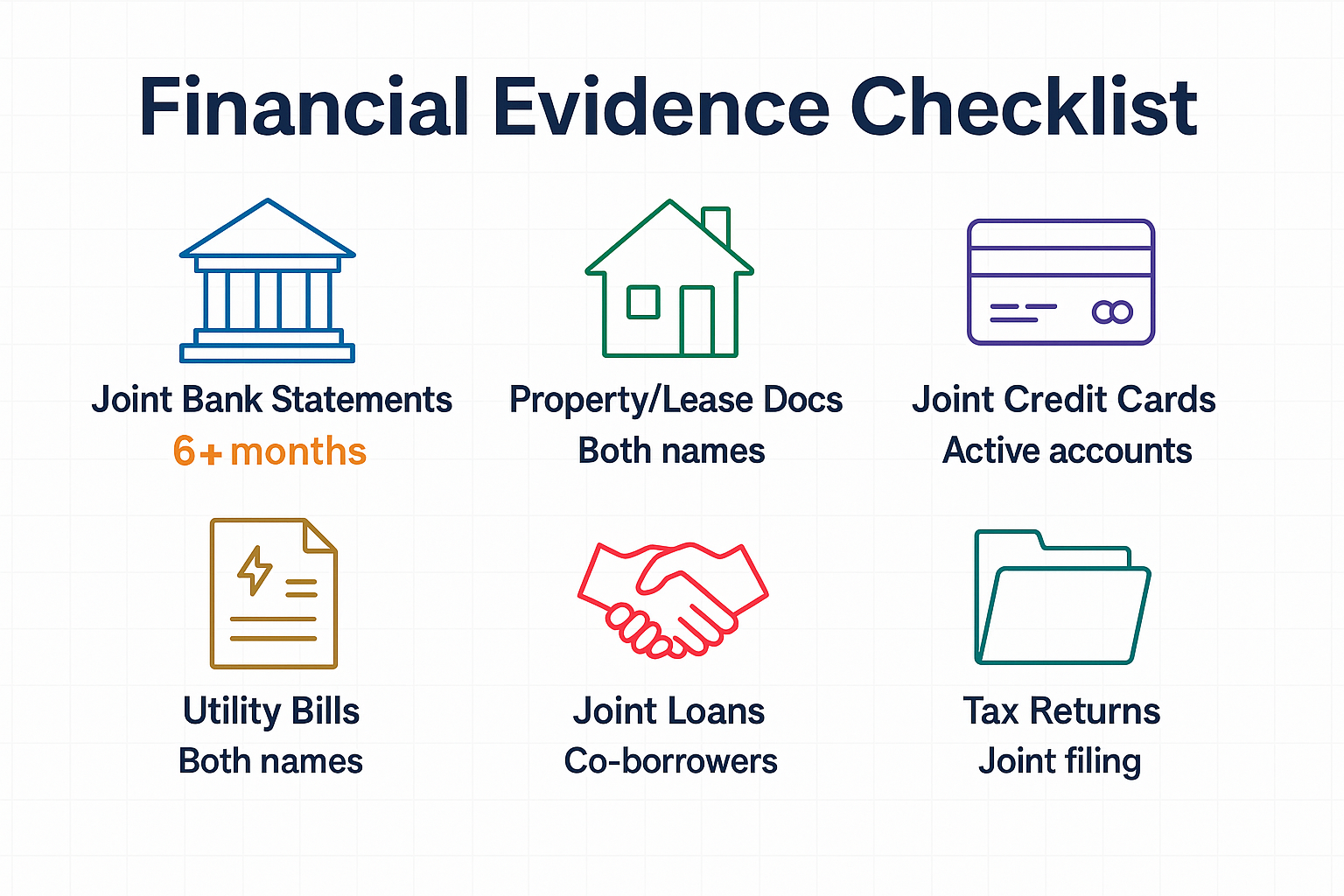
When couples share their finances, it demonstrates trust, commitment, and the intertwining of lives that characterizes real marriages. USCIS typically wants to see at least six months of joint bank account statements showing regular activity from both spouses[7].
Strong financial evidence includes:
📊 Joint checking accounts with both names and regular transactions
📊 Joint savings accounts showing shared financial goals
📊 Joint credit cards with both spouses as account holders
📊 Joint investment accounts or retirement accounts
📊 Joint loans (auto loans, personal loans, student loan refinancing)
The statements should show your names, account numbers, and transaction history. Highlight deposits, withdrawals, and purchases that reflect your daily life together.
Joint Property Ownership and Leases
Sharing a home is one of the strongest indicators of a genuine marriage. Documentation proving you live together carries significant weight.
Property and housing evidence:
🏠 Mortgage documents in both names
🏠 Property deeds showing joint ownership
🏠 Lease agreements with both spouses listed as tenants
🏠 Rental payment receipts from both spouses
🏠 Homeowners or renters insurance policies listing both spouses
If only one spouse's name appears on the lease or mortgage, you can supplement with other evidence like utility bills, mail addressed to both spouses at the same address, and affidavits from landlords.
Utility Bills and Household Expenses
Bills in both spouses' names prove you're not just sharing an address—you're sharing a household.
Utility and household documentation:
- Electric, gas, or water bills
- Internet and cable service
- Cell phone plans (especially family plans)
- Streaming service subscriptions
- Gym memberships
- Car insurance policies
Submit bills covering several months to show an established pattern of cohabitation.
Identity and Background Documentation
Government-Issued Identification
What identification documents does USCIS require for a marriage green card?
Both spouses must provide comprehensive identification to verify their identities and establish legal status. For the foreign spouse, this documentation also proves lawful entry into the United States if applying for adjustment of status.
Required identification documents:
🆔 Passport (all pages, including blank pages and all visa stamps)
🆔 Birth certificate with certified English translation if needed
🆔 National identification card from your home country
🆔 Driver's license (U.S. or foreign)
🆔 Previous immigration documents (I-94, visa approvals, previous green cards)
Make clear, legible copies of every page. Don't skip blank passport pages—USCIS wants to see the complete document.
Police Certificates and Background Checks
USCIS requires police certificates from every country where you've lived for more than six months since age 16[8]. This is a security measure to ensure you don't have a criminal history that would make you inadmissible.
Police certificate requirements:
- Must be issued by the appropriate police authority
- Should cover your entire period of residence in that country
- Must be recent (typically within one year of application)
- Requires certified English translation if in a foreign language
- Must include your full name, date of birth, and any findings
Some countries have lengthy processing times for police certificates. Start this process early to avoid delays.
Military Records
If either spouse has served in any country's military, you'll need to provide military service records. This includes:
- Discharge papers (DD-214 for U.S. military)
- Service record books
- Documentation of rank and dates of service
- Character of discharge
Proving Your Relationship Is Genuine
Wedding Photographs and Ceremony Documentation
How many wedding photos should you submit for your marriage green card application?
While there's no magic number, quality matters more than quantity. USCIS officers want to see evidence of a real wedding celebration with family and friends—not just a courthouse ceremony with two witnesses (though those are legally valid too).
Effective wedding photo evidence:
📸 Ceremony photos showing the exchange of vows
📸 Reception photos with guests, family, and friends
📸 Photos with both families together
📸 Detail shots (rings, cake cutting, first dance)
📸 Guest book pages with signatures and messages
📸 Wedding invitations and programs
📸 Receipts from vendors (venue, catering, photography)
Submit 15-20 well-chosen photos rather than 100 random snapshots. Include captions with names, dates, and locations.
Photographs Throughout Your Relationship
Beyond wedding photos, USCIS wants to see visual evidence of your relationship's progression over time.
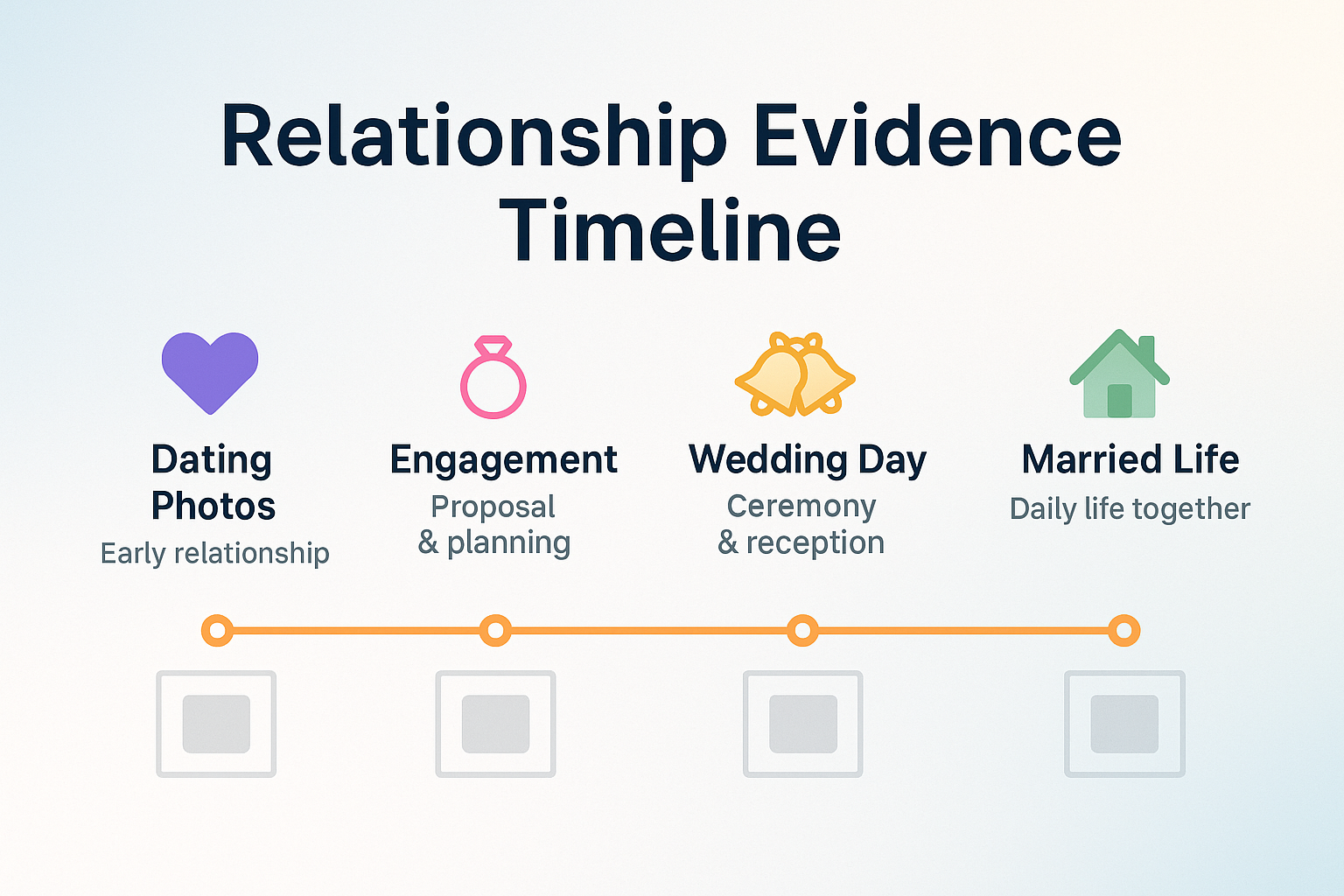
Relationship timeline photos:
- Dating photos from before marriage
- Holiday celebrations together
- Vacations and travel
- Daily life moments (cooking together, at home, with pets)
- Photos with each other's families
- Major life events (birthdays, graduations, achievements)
Organize photos chronologically and caption them clearly. Show the natural evolution of your relationship from dating through engagement to married life.
Travel Documentation
Trips taken together demonstrate shared experiences and the kind of life-building that genuine couples do.
Travel evidence includes:
✈️ Airline tickets or boarding passes for joint travel
✈️ Hotel reservations in both names
✈️ Vacation photos with recognizable landmarks
✈️ Passport stamps showing coordinated travel dates
✈️ Cruise bookings or tour receipts
✈️ Car rental agreements in both names
Even weekend getaways or visits to family count. Every bit of evidence helps paint a complete picture.
Communication Records and Correspondence
Digital Communication Evidence
In 2025, most couples communicate primarily through digital channels. This electronic trail can serve as powerful evidence.
Digital communication to consider:
💬 Text message screenshots showing ongoing conversation
💬 Email exchanges (especially during periods of separation)
💬 Social media messages (Facebook, WhatsApp, Instagram)
💬 Video call logs (Skype, Zoom, FaceTime history)
💬 Dating app conversations from how you met
You don't need to submit every text message you've ever sent. Choose representative samples that show affection, daily life discussions, and future planning.
Social Media Evidence
Your public social media presence can support your case, especially if you've been posting about your relationship openly.
Social media evidence:
- Facebook relationship status showing you're married
- Instagram posts featuring your spouse
- Couple photos with friends' comments and likes
- Anniversary or birthday posts
- Tagged locations showing you together
- Shared friend networks
Print screenshots with visible dates and URLs. Highlight comments from family and friends acknowledging your relationship.
Letters and Cards
Traditional correspondence still matters, especially cards exchanged during holidays, birthdays, and anniversaries.
Meaningful correspondence:
- Birthday cards with handwritten messages
- Anniversary cards
- Valentine's Day cards
- Holiday cards sent as a couple
- Thank-you notes from wedding guests
- Letters from family members acknowledging the marriage
These personal touches show emotional connection and the small, meaningful gestures that characterize real relationships.
Additional Supporting Evidence
Joint Tax Returns
Filing taxes jointly is one of the strongest pieces of evidence you can provide for a marriage green card application[9]. It demonstrates financial interdependence and a legal commitment recognized by the IRS.
Tax documentation to include:
- Complete copies of joint federal tax returns (Form 1040)
- State tax returns if applicable
- W-2s and 1099s for both spouses
- Tax transcripts from the IRS
If you haven't been married long enough to file jointly, include individual returns and a statement explaining the timing.
Insurance Policies
Adding your spouse to your insurance policies shows you're planning a future together and taking care of each other.
Insurance evidence:
🛡️ Health insurance with spouse as dependent or beneficiary
🛡️ Life insurance naming spouse as beneficiary
🛡️ Auto insurance with both spouses listed
🛡️ Homeowners or renters insurance in both names
🛡️ Dental and vision insurance covering both spouses
Include policy declarations pages showing names, coverage dates, and beneficiary designations.
Affidavits from Family and Friends
Third-party statements from people who know you as a couple add credibility to your application.
Effective affidavits should:
- Come from people who know both spouses well
- Describe how long they've known you
- Include specific details about your relationship
- Mention time spent together (dinners, holidays, events)
- Be notarized for added authenticity
- Include the affiant's contact information
Request affidavits from 3-5 people who can speak meaningfully about your relationship—quality over quantity.
Children Born to the Marriage
If you have children together, their birth certificates are powerful evidence of your genuine marriage.
Documentation for children:
- Birth certificates listing both parents
- Medical records showing both parents
- School records with both parents listed
- Photos of your family together
- Childcare arrangements in both names
Organizing Your Marriage Green Card Evidence
Creating a Logical Structure
How should you organize all this documentation for USCIS?
Think of your application package as telling a story—the story of your relationship. Organize documents in a way that makes sense and allows the reviewing officer to follow your journey easily.
Recommended organization structure:
- Cover letter summarizing your case
- Forms section (I-130, I-485, I-693, I-864, etc.)
- Legal marriage documentation (marriage certificate, previous divorce decrees)
- Identity documents (passports, birth certificates)
- Financial evidence (bank statements, tax returns, property documents)
- Cohabitation proof (leases, utility bills)
- Relationship evidence (photos, travel, communication)
- Supporting documents (affidavits, insurance, children's documents)
Labeling and Documentation
Make the officer's job easier by clearly labeling everything.
Best practices for organization:
📋 Use tabs or dividers to separate sections
📋 Create a table of contents listing all documents
📋 Label each document with a brief description
📋 Arrange chronologically within each section
📋 Use page numbers for easy reference
📋 Include a cover letter explaining your case overview
Making Copies and Keeping Records
Never send original documents unless specifically required (like the marriage certificate). Keep copies of everything you submit.
Document management tips:
- Make at least two copies of your complete application
- Scan everything and save digital backups
- Keep originals in a safe place
- Track your submission with certified mail
- Save all USCIS correspondence and receipts
- Maintain a timeline of important dates
Common Mistakes to Avoid
Insufficient Evidence
What's the most common reason marriage green card applications face delays?
Submitting too little evidence—or evidence that doesn't adequately demonstrate the genuine nature of your relationship—is the primary cause of Requests for Evidence (RFEs) and delays[10].
Evidence mistakes to avoid:
❌ Submitting only the bare minimum required documents
❌ Providing evidence from only one time period
❌ Including photos without context or captions
❌ Failing to translate foreign-language documents
❌ Submitting poor-quality copies that are illegible
❌ Forgetting to sign forms or include filing fees
Inconsistencies in Your Application
USCIS officers are trained to spot inconsistencies. Small discrepancies can raise red flags.
Watch out for:
- Different addresses listed on various forms
- Conflicting dates or timelines
- Variations in name spelling
- Contradictory statements in affidavits
- Photos with metadata showing different dates than claimed
Review your entire application multiple times. Have your spouse review it too. Consistency is key.
Using Outdated Forms
As mentioned earlier, USCIS only accepts current form editions. Using an outdated version—even if you started filling it out when it was current—will result in rejection.
Form version best practices:
✓ Download forms fresh from USCIS.gov when you're ready to file
✓ Check the edition date in the bottom left corner
✓ Review USCIS alerts for form updates
✓ Don't use forms you downloaded months ago
Missing Deadlines
Immigration applications have strict deadlines. Missing them can have serious consequences.
Critical deadlines to track:
- Response deadlines for RFEs (typically 87 days)
- Medical exam validity (must be submitted within specific timeframes)
- Interview appointment dates
- Biometrics appointments
- Conditional green card removal deadlines (if applicable)
Set calendar reminders well in advance of any deadline.
When to Seek Professional Help
Complex Situations That Benefit from Attorney Guidance
Should you hire an immigration attorney for your marriage green card application?
While many couples successfully navigate the process on their own, certain situations significantly benefit from professional legal guidance. An experienced immigration attorney can help you avoid costly mistakes and strengthen your case from the beginning.
Consider hiring an attorney if:
🔍 Either spouse has a criminal history (even minor offenses can affect admissibility)
🔍 Previous immigration violations exist (overstays, unauthorized work, misrepresentation)
🔍 Prior denied applications or immigration issues
🔍 Complex financial situations (self-employment, insufficient income, need for joint sponsor)
🔍 Previous marriages with complicated divorce histories
🔍 Age difference or cultural factors that might raise questions
🔍 Language barriers that make forms difficult to complete accurately
🔍 Time-sensitive situations requiring expedited processing
What an Immigration Attorney Can Do for You
An attorney does more than just fill out forms. They provide strategic guidance tailored to your specific situation.
Attorney services include:
- Reviewing your eligibility before you invest time and money
- Identifying potential issues and developing strategies to address them
- Ensuring all forms are completed accurately and completely
- Gathering and organizing evidence effectively
- Preparing you for your interview
- Communicating with USCIS on your behalf
- Responding to RFEs and handling complications
- Representing you if issues arise
We know this process can feel overwhelming. You don't have to face it alone—we'll help you find the right attorney and understand every step before you take it.
The Interview: What to Expect
Preparing for Your Marriage Green Card Interview
What happens during a marriage green card interview?
After USCIS reviews your application, you'll be scheduled for an in-person interview at a local USCIS office. Both spouses must attend. The interview typically lasts 15-30 minutes and focuses on verifying the information in your application and assessing whether your marriage is genuine[11].
Interview preparation tips:
📝 Review your entire application thoroughly before the interview
📝 Bring original documents (marriage certificate, passports, IDs)
📝 Bring additional evidence collected since filing
📝 Dress professionally and arrive early
📝 Be honest and consistent in your answers
📝 Speak clearly and ask for clarification if needed
Common Interview Questions
The officer will ask questions about your relationship, daily life, and future plans.
Typical questions include:
- How did you meet?
- When did you get engaged?
- Who proposed and how?
- Describe your wedding ceremony.
- Where do you live?
- What does your home look like?
- What are your spouse's daily routines?
- How do you split household chores?
- What are your future plans together?
- Do you plan to have children?
Answer naturally and honestly. It's okay to say "I don't know" rather than guessing.
After the Interview
In many cases, the officer will make a decision during or immediately after the interview. You may receive:
Possible outcomes:
✅ Approval – Your green card will be mailed within 2-3 weeks
📋 Request for Evidence – Additional documentation is needed
⏸️ Administrative processing – Additional background checks required
❌ Denial – Your application is denied (you have appeal rights)
If approved, congratulations! If you receive an RFE or face denial, this is when having an attorney becomes especially valuable.
Timeline and Processing Expectations for 2025
How Long Does the Marriage Green Card Process Take?
What's the realistic timeline for getting a marriage green card in 2025?
Processing times vary significantly based on several factors: whether you're married to a U.S. citizen or permanent resident, whether you're adjusting status from within the U.S. or applying from abroad, and which USCIS service center handles your case.
General timeline estimates for 2025:
⏱️ I-130 processing: 10-18 months (varies by service center)
⏱️ I-485 processing: 12-24 months for most applicants
⏱️ Total process (concurrent filing): 12-24 months typically
⏱️ Consular processing: 12-18 months from start to visa issuance
These are estimates. Your actual timeline may be shorter or longer.
Factors That Affect Processing Times
Several variables influence how quickly your application moves through the system.
Timeline factors:
- Service center workload (some centers process faster than others)
- Completeness of application (RFEs cause delays)
- Background check complexity (security clearances take time)
- Interview scheduling (appointment availability varies by location)
- USCIS staffing and policy changes
- Premium processing (not available for I-485, but available for some related petitions)
You can check current processing times on the USCIS website for your specific service center and form type.
Tracking Your Application
Once you file, you'll receive receipt notices with case numbers. Use these to track your case.
Tracking methods:
- USCIS online case status tool
- USCIS Contact Center (1-800-375-5283)
- Case status email and text updates
- USCIS online account (if you filed electronically)
- InfoPass appointments for in-person inquiries
Be patient but proactive. If your case exceeds normal processing times, you can submit a case inquiry.
Conditional vs. Permanent Green Cards
Understanding the Two-Year Conditional Period
Will your marriage green card be conditional or permanent?
If your marriage is less than two years old when your green card is approved, you'll receive a conditional green card valid for two years rather than the standard 10-year permanent green card[12]. This is a fraud prevention measure.
Conditional green card characteristics:
🕐 Valid for 2 years from the date of issuance
🕐 Provides same rights as permanent green card (work, travel, live in U.S.)
🕐 Requires removal of conditions before expiration
🕐 Must file Form I-751 jointly with your spouse 90 days before expiration
Removing Conditions on Your Green Card
The process of removing conditions involves filing Form I-751 (Petition to Remove Conditions on Residence) jointly with your spouse.
I-751 requirements:
- Must be filed 90 days before conditional green card expires
- Requires updated evidence that your marriage is still genuine
- Both spouses must sign the petition
- Filing fee required
- Updated photos and evidence of continued marriage
- Proof of ongoing cohabitation and shared life
After filing I-751, you'll receive a receipt notice that extends your conditional green card for 18 months while USCIS processes your petition.
What If You're Divorced Before Removing Conditions?
If your marriage ends before you can remove conditions, you can still apply—but you'll need to request a waiver and provide evidence that the marriage was genuine when entered.
Waiver situations:
- Divorce or annulment (marriage was entered in good faith)
- Abuse or extreme hardship
- Death of the U.S. citizen spouse
These situations are complex and almost always require attorney assistance.
Costs and Fees for Marriage Green Card Applications in 2025

Filing Fees and Government Costs
How much does it cost to apply for a marriage green card?
USCIS filing fees change periodically, and they represent a significant financial investment. As of 2025, expect to pay several thousand dollars in government fees alone.
Estimated 2025 filing fees:
💰 Form I-130: $625
💰 Form I-485: $1,440 (includes biometrics fee)
💰 Form I-864: No separate fee
💰 Form I-693 (medical exam): $200-$500 (paid to civil surgeon, not USCIS)
💰 Total government fees: Approximately $2,065-$2,365
Note: Fees are subject to change. Always verify current fees on USCIS.gov before filing.
Additional Costs to Budget For
Beyond government fees, you'll incur other expenses throughout the process.
Additional expenses:
- Document translation: $20-$50 per page
- Police certificates: $10-$100 per country
- Passport photos: $10-$20
- Document copies and printing: $50-$100
- Postage and certified mail: $20-$50
- Travel to interview: Varies by location
- Attorney fees: $1,500-$5,000+ if you hire legal help
Budget for a total cost of $3,000-$7,000 or more depending on your situation and whether you use an attorney.
Payment Methods
USCIS accepts specific payment methods for filing fees.
Accepted payment forms:
✓ Personal check
✓ Money order
✓ Cashier's check
✓ Credit card (using Form G-1450)
Make checks payable to "U.S. Department of Homeland Security." Never send cash.
Special Situations and Considerations
Same-Sex Marriages
Since the Supreme Court's 2015 decision in Obergefell v. Hodges, same-sex marriages are treated identically to opposite-sex marriages for immigration purposes[13]. You follow the exact same process and submit the same evidence.
Important considerations:
- Your marriage must be legally valid where it was performed
- USCIS recognizes all legal marriages regardless of gender
- Evidence requirements are identical
- Some countries may not recognize same-sex marriages (affects consular processing)
Age Differences and Cultural Marriages
Significant age differences or marriages arranged through cultural traditions may receive additional scrutiny, but they're not automatically problematic.
Strengthening your case:
- Provide extra evidence of genuine relationship
- Include affidavits explaining cultural context
- Document how you met and developed your relationship
- Show integration of families and communities
- Be prepared to discuss your relationship in detail at the interview
Previous Immigration Violations
If the foreign spouse has overstayed a visa, worked without authorization, or committed other immigration violations, the situation becomes more complex.
Possible issues:
- Unlawful presence triggers bars to reentry (3-year or 10-year bars)
- Fraud or misrepresentation can result in permanent bars
- Certain violations may require waivers
- Some violations make adjustment of status impossible
These situations almost always require consultation with an experienced immigration attorney who can evaluate your options.
Resources and Next Steps
Official USCIS Resources
Where can you find reliable information about the marriage green card process?
Start with official government sources to ensure you're getting accurate, up-to-date information.
Trusted resources:
🔗 USCIS.gov – Official forms, instructions, and policy guidance
🔗 USCIS Contact Center – 1-800-375-5283 for case-specific questions
🔗 USCIS Online Account – Track your case and receive updates
🔗 State Department – Information for consular processing
🔗 IRS.gov – Tax return copies and transcripts
Finding a Qualified Immigration Attorney
If you decide professional help would benefit your case, finding the right attorney is important.
How to find a qualified attorney:
- State bar association referral services
- American Immigration Lawyers Association (AILA)
- Recommendations from friends or family who've been through the process
- Online reviews and ratings (verify credentials independently)
- Initial consultations (many attorneys offer free or low-cost consultations)
Questions to ask potential attorneys:
- How many marriage green card cases have you handled?
- What's your success rate?
- What are your fees and payment structure?
- Will you personally handle my case or delegate to staff?
- How will we communicate throughout the process?
- What's your assessment of my specific situation?
At Attorney Engine, we've spent over a decade helping people connect with experienced immigration attorneys who genuinely care about their clients. We know this process can feel overwhelming, and we're here to help you find the right legal support for your unique situation.
Conclusion: Moving Forward with Confidence
Gathering evidence for your marriage green card application requires patience, organization, and attention to detail—but you can do this. By understanding what USCIS needs to see and preparing thoroughly, you're taking control of your future together.
Remember these key principles:
✅ Start early – Begin collecting documents as soon as you decide to apply
✅ Be thorough – More evidence is better than less
✅ Stay organized – Clear organization helps USCIS review your case efficiently
✅ Be honest – Truthfulness is essential throughout the process
✅ Seek help when needed – Complex situations benefit from professional guidance
The path from application to approval may feel long, but thousands of couples successfully navigate it every year. Your marriage is real, your love is genuine, and with proper preparation, your evidence will demonstrate that clearly.
Your Next Steps
Ready to begin your marriage green card journey?
- Review this evidence list and identify which documents you already have
- Create a collection timeline for documents you need to obtain
- Start organizing your evidence into logical categories
- Download current forms from USCIS.gov when you're ready to begin
- Consider consulting an attorney if your situation is complex
You don't need to have all the answers today. You just need to take one step—and we'll help you make sure it's the right one.
Legal problems are stressful enough. Finding a lawyer shouldn't add to it. If you need guidance, Attorney Engine can help you connect with experienced immigration attorneys who understand what you're going through and will treat your case with the care and attention it deserves.
Your new life together in the United States is worth the effort. Take it one document at a time, stay organized, and move forward with confidence.
Frequently Asked Questions
How long does it take to get a marriage green card in 2025?
The marriage green card process typically takes 12-24 months from initial filing to approval for most applicants adjusting status within the United States. Processing times vary based on your USCIS service center, the completeness of your application, and whether you're married to a U.S. citizen or permanent resident. Consular processing from abroad follows a similar timeline of 12-18 months. You can check current processing times for your specific service center on the USCIS website.
Can I work while my marriage green card application is pending?
Yes, you can apply for work authorization by filing Form I-765 (Application for Employment Authorization) along with your I-485 adjustment of status application. USCIS typically approves employment authorization documents (EADs) within 3-5 months of filing. Once you receive your EAD, you can work legally in the United States while your green card application is being processed. You can also apply for advance parole travel authorization using Form I-131.
What happens if we don't have joint financial accounts?
While joint financial accounts are strong evidence, they're not absolutely required. Some couples maintain separate finances for various legitimate reasons. If you don't have joint accounts, you can compensate with other evidence such as: naming your spouse as beneficiary on accounts or insurance policies, including your spouse on your lease or mortgage, providing affidavits from family and friends, submitting extensive relationship documentation (photos, travel, communication), and explaining your financial arrangement in a cover letter. The key is demonstrating your genuine relationship through the totality of evidence.
Do we need an attorney for our marriage green card application?
Many couples successfully complete the marriage green card process without an attorney, especially if their situation is straightforward: first marriage for both spouses, no criminal history, no immigration violations, clear evidence of genuine relationship, and sufficient income to meet financial requirements. However, an attorney is strongly recommended if you have any complicating factors such as criminal history, previous immigration violations, prior denied applications, complex financial situations, or significant age or cultural differences. An experienced immigration attorney can help you avoid costly mistakes and strengthen your case from the beginning.
What if our marriage is less than two years old when the green card is approved?
If your marriage is less than two years old when USCIS approves your green card, you'll receive a conditional green card valid for two years rather than the standard 10-year permanent green card. This is a fraud prevention measure and doesn't mean USCIS doubts your marriage. You'll need to file Form I-751 (Petition to Remove Conditions on Residence) jointly with your spouse during the 90-day period before your conditional green card expires. This petition requires updated evidence that your marriage remains genuine and you're still living together as a married couple.
References
[1] U.S. Citizenship and Immigration Services. (2025). "Green Card for Immediate Relatives of U.S. Citizen." USCIS.gov.
[2] U.S. Citizenship and Immigration Services. (2025). "I-130, Petition for Alien Relative." USCIS.gov.
[3] U.S. Citizenship and Immigration Services. (2025). "I-485, Application to Register Permanent Residence or Adjust Status." USCIS.gov.
[4] U.S. Citizenship and Immigration Services. (2025). "I-693, Report of Medical Examination and Vaccination Record." USCIS.gov.
[5] U.S. Citizenship and Immigration Services. (2025). "I-864, Affidavit of Support Under Section 213A of the INA." USCIS.gov.
[6] U.S. Department of State. (2025). "Marriage-Based Immigrant Visa." Travel.State.gov.
[7] U.S. Citizenship and Immigration Services. (2025). "Policy Manual: Evidence of Bona Fide Marriage." USCIS.gov.
[8] U.S. Department of State. (2025). "Reciprocity and Civil Documents by Country." Travel.State.gov.
[9] Internal Revenue Service. (2025). "Filing Status." IRS.gov.
[10] U.S. Citizenship and Immigration Services. (2025). "Requests for Evidence and Notices of Intent to Deny." USCIS.gov.
[11] U.S. Citizenship and Immigration Services. (2025). "The Green Card Interview." USCIS.gov.
[12] U.S. Citizenship and Immigration Services. (2025). "Conditional Permanent Residence." USCIS.gov.
[13] U.S. Citizenship and Immigration Services. (2025). "Same-Sex Marriages." USCIS.gov.
SEO Meta Title and Description
Meta Title: Marriage Green Card Evidence List: Complete 2025 Guide
Meta Description: Complete evidence list for marriage green card applications in 2025. Learn required documents, forms, financial proof, and relationship evidence for USCIS approval.